
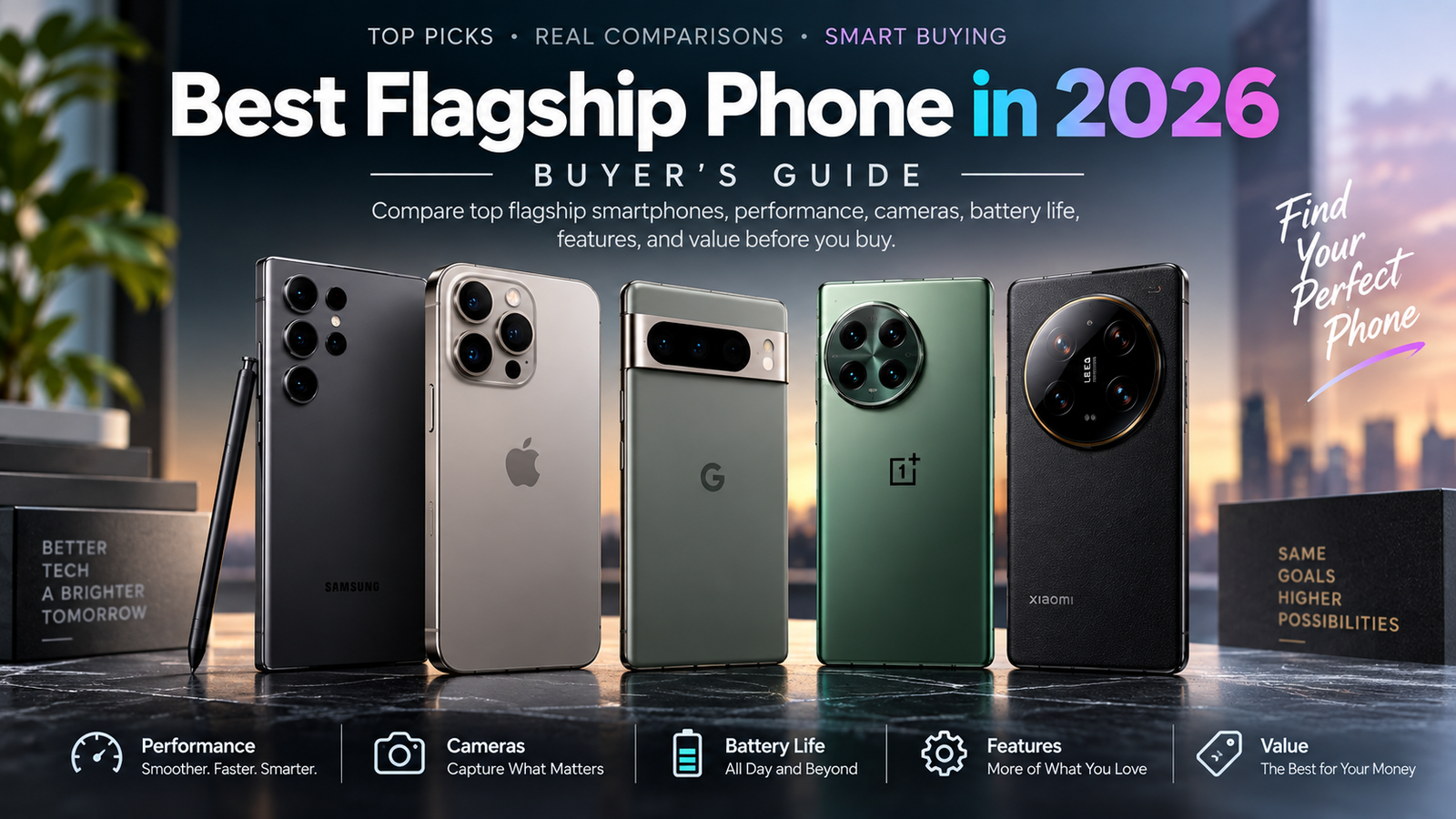
A flagship phone is the top-tier phone built for the best all-around experience, not just the highest price tag. If you are trying to find the best flagship phone in 2026, the real question is simpler than the spec sheets make it look: which phone feels fast, takes great photos, lasts through the day, and stays useful for years?
Table of Contents
What makes the best flagship phone in 2026
In 2026, “flagship phone” means the phone that gets the important things right without making you compromise too much. You should expect top performance, a bright display, excellent cameras, strong battery life, and software that will not feel old after a couple of updates. Think of it like choosing the best seat on a flight, not the fanciest one with a champagne tray. The value is in comfort, reliability, and the stuff you notice every day.
The best flagship phone in 2026 is not automatically the most expensive model. A phone can cost a fortune and still be awkward to hold, annoying to charge, or overkill for your needs. What matters is how well it handles real life, from checking messages in a coffee shop to editing photos on a train ride home.
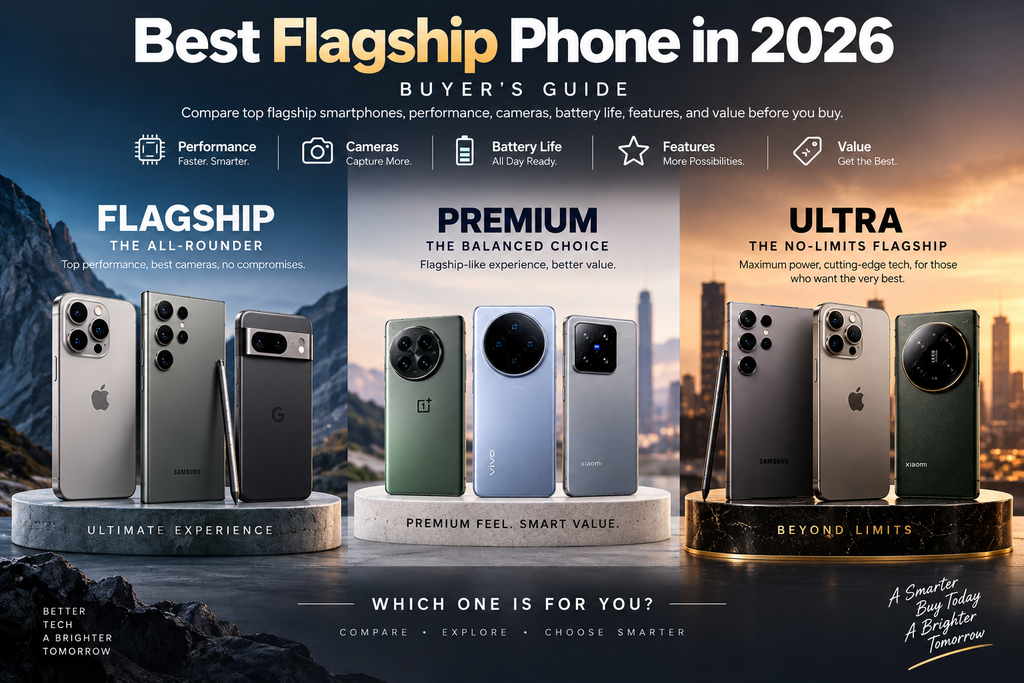
Flagship Phone vs. premium vs. ultra
A flagship is the brand’s main high-end phone. It usually has the fastest chip, the best balance of features, and the most polished software experience.
A premium phone sits just below that. It still feels nice, but it may cut back on camera hardware, materials, display brightness, or long-term support. You get a good phone, just not the full meal.
An ultra model goes even further, usually with a bigger screen, more advanced cameras, or niche features like extreme zoom or stylus support. Ultra sounds better, but bigger is not always better. If a phone feels like carrying a paperback brick, that novelty wears off fast.
What changed in 2026
The biggest shift in 2026 is that phones are getting smarter in ways you can actually use. On-device AI, meaning AI that runs on the phone instead of in the cloud, is now doing more of the heavy lifting for photo editing, call screening, summaries, and voice tools. That matters because it is faster, more private, and less dependent on a strong data connection.
Battery efficiency has also improved. New chips are doing more work without draining power as quickly, and charging speeds keep climbing. Camera upgrades are less about flashy megapixel numbers and more about better detail in low light, steadier video, and faster processing after you tap the shutter. In plain English, your phone spends less time thinking and more time getting out of your way.
How to choose the right flagship phone for you
A good flagship phone should fit the way you actually live with it. After a week, you will notice speed, battery, camera reliability, and comfort far more than any marketing claim about peak brightness or maximum zoom.
Performance and speed
Performance comes from the chipset, which is the phone’s main brain, plus RAM, which helps it keep apps ready in memory. More important than raw specs is how smoothly the phone handles your routine. Opening apps, switching between messages and maps, taking photos, and jumping into a game should feel instant.
A well-tuned phone can feel faster than a spec monster that is poorly optimized. That is why software matters so much. If you keep a phone for three or four years, you want it to stay smooth when apps get heavier and camera processing gets more demanding.
Camera quality
A great flagship camera is not just about sharp photos in bright sunlight. You want a strong main sensor, reliable autofocus, good zoom, clean low-light shots, and video that does not wobble like you are filming from a bike. Portrait mode should separate subject and background naturally instead of making hair look cut out with scissors.
The best camera depends on what you shoot most. If your camera roll is full of people and pets, consistency matters more than huge zoom numbers. If you love concerts, travel, or street photography, zoom and night performance matter more. If you post video often, stabilization and microphone quality suddenly move to the top of the list.
Battery life and charging
Battery size matters, but efficiency matters just as much. A phone with a smaller battery can still outlast a bigger one if the chip and software sip power instead of guzzling it. That is why one phone can make it to dinner with 30 percent left while another is begging for a charger at 4 p.m.
Fast charging is useful, but not if it cooks the battery over time. Wireless charging is nice for a desk or nightstand, though wired charging is still the faster option when you are in a hurry. The best balance is a phone that lasts all day, tops up quickly, and does not feel fragile after a year of charging cycles.
Display and build
The display is the part of the phone you stare at all day, so it matters more than people admit. A bright screen helps outdoors, a high refresh rate makes scrolling feel smoother, and accurate color makes photos and video look right instead of weirdly oversaturated. Once you use a truly good display, everything else feels a little less polished.
Build quality affects how the phone feels in your hand and how it handles real accidents. Durable glass, metal frames, and water resistance do not make a phone indestructible, but they do make daily use less stressful. A phone that survives a splash at the sink or a rainy walk to the car is a phone you stop babying.
Looking for the best flagship phone in 2026? Compare top flagship smartphones, performance, cameras, battery life, features, and value before you buy.
Software and update support
Software support decides how long your phone stays worth owning. Longer update windows mean better security, new features, and fewer reasons to replace the device early. Clean software can feel calm and fast, while cluttered software can make even an expensive phone feel messy.
AI tools also matter here, but only if they save time. Photo cleanup, live transcription, call screening, and quick summaries are helpful because they remove small annoyances. If a feature sounds impressive but never shows up in your routine, it is just decoration.
The best flagship phone types to consider
The right flagship depends on what you value most. That is the practical way to shop, because no single phone is the best at everything.
Best all-around flagship
The best all-around flagship gives you strong performance, a great display, reliable cameras, and battery life that does not make you watch the percentage like a hawk. It is the safe choice if you want one phone to do everything well without leaning too hard into one gimmick.
This is usually the sweet spot for most people. It feels fast on day one and still feels sensible two years later, which is what really counts.
Best flagship phone for photography
If photography is the reason you are spending flagship money, look for a phone with excellent color, strong low-light performance, and a zoom camera that is actually useful, not just a box to tick on the spec sheet. The best camera phones also process images quickly, so you do not miss the moment while the phone is trying to be clever.
For this kind of buyer, the camera roll matters more than benchmark scores. A model that nails portraits, night shots, and video stabilization will give you more real value than one that simply advertises a giant sensor.
Best flagship phone for battery life
Looking for the best flagship phone in 2026? Compare top flagship smartphones, performance, cameras, battery life, features, and value before you buy.
If your days run long, battery life becomes the whole story. You want a phone that can handle commuting, calls, maps, streaming, and photos without making you hunt for a charger at a café in the middle of the afternoon.
The trick is to look beyond battery size alone. A slightly smaller battery can still win if the hardware is efficient and the software is smart about power use. That is the difference between a phone that just survives and one that calmly gets you through the day.
Best flagship phone for gaming and power users
Power users need sustained performance, not just a flashy launch score. That means a strong chipset, good thermal management, and a display that keeps up during long sessions. Thermal management is simply how well the phone handles heat before it slows itself down.
If you game a lot, also pay attention to speakers and touch response. A phone that stays cool, keeps frame rates steady, and sounds good without headphones feels noticeably better after an hour than one that wins only on paper.
Best flagship phone for a clean, easy-to-use experience
Some phones are about speed, others are about simplicity. If you want a phone that feels easy from the start, look for clean software, consistent updates, and fewer preinstalled extras cluttering the menus.
This is the right choice if you do not want to babysit settings. A calm interface, sensible notifications, and smooth app behavior can be more satisfying than a pile of flashy features you never touch.
Features worth paying extra for
Not every premium feature deserves your money. A few do, especially if they match how you use your phone.
Satellite connectivity and emergency tools
Satellite messaging and emergency features are worth understanding if you travel, hike, or spend time in places with weak signal. They are not daily-use features for most people, but when they matter, they matter a lot.
Think of them as insurance built into the phone. You hope not to use them, but having them on a remote road trip or in a dead zone is a real comfort.
AI features that save time
The best AI features are the boring ones that quietly help you get things done. Call screening, note summaries, voice transcription, photo cleanup, and smart search tools can save minutes every day. That sounds small, but small savings add up fast.
Skip the hype and focus on usefulness. If an AI feature helps you answer faster, organize better, or edit quicker, it earns its place. If it just makes a demo look cool, move on.
Storage and memory
Storage fills up faster than most people expect. Photos, 4K video, downloaded playlists, offline maps, and apps all eat space. For a flagship in 2026, 256GB is a safer baseline than 128GB, especially if you keep phones for years.
RAM matters too, but only up to a point. Once you have enough to keep your apps alive in the background, the experience depends more on software quality than on chasing the biggest number on the box.
What to watch out for before you buy
The unboxing excitement fades quickly if the phone does not fit your hand, your pocket, or your habits. A few common mistakes are easy to avoid.
Oversized flagship phones that sound better than they feel
Bigger phones promise bigger screens, but you pay for that with weight, pocket bulk, and one-handed awkwardness. A giant phone can feel great on a couch and annoying everywhere else, like choosing the suitcase with the huge capacity that turns miserable on a subway platform.
If you text a lot, take photos one-handed, or carry your phone around all day, comfort matters more than raw screen size. Do not buy a slab just because it looks impressive in a spec table.
Paying for specs you Won’t notice
A phone can brag about extreme zoom, massive brightness, or niche productivity features and still not improve your life much. If you never print photos, zoom to the moon is probably wasted. If you mostly browse, stream, and message, a top-end camera array may be more than you need.
Buy for your habits, not for bragging rights. The best flagship phone in 2026 is the one that fits what you do most days, not the one that wins a marketing battle.
Missing ecosystem fit
Your phone should play nicely with your laptop, earbuds, watch, and cloud services. If your devices already live in one ecosystem, staying inside it often makes life easier. Messages sync better, files move faster, and setup is less annoying.
Switching ecosystems can feel like replacing half your kitchen just to get a new spoon. Sometimes that trade is worth it, but only if the phone itself clearly gives you something you will feel every day.
Quick flagship phone buying checklist
Before you spend flagship money, keep your decision grounded in the basics. Battery life, camera needs, software support, and size should come before fancy extras.
Check these four things first
Make sure the phone lasts through your normal day, takes the kind of photos you care about, gets enough years of updates, and feels comfortable in your hand. Those four details decide whether you love the phone or quietly tolerate it.
Pick the flagship phone that fits your daily routine
A phone for travel looks different from a phone for work, and both look different from a phone for gaming or photography. Match the device to your normal week, not your rare weekend fantasy.
One final rule before you buy
The best flagship phone in 2026 is the one that feels fast, lasts all day, takes the photos you want, and stays useful for years. Get that part right, and the rest gets a lot easier.
I hope you liked this article, if you feel like its helpful please share with your firends and family. MarketGuidely is here to help you anytime
Author

marketguidely@gmail.com
Related Posts
The Best Wireless Earbuds Under ₹2000
- 0
- 1,839 word
Wireless Earbuds Under ₹2000 Spending ₹2000 on wireless earbuds in India used to mean accepting tinny sound, flimsy plastic, and a battery...
Read out all
Things to Check Before Buying a Laptop: 10 Smart Tips for a Better Buy in 2026
- 0
- 3,077 words
Buying a used laptop can feel like a shortcut until you realize the “deal” comes with a dying battery, a warped hinge,...
Read out all
Things to Check Before Buying a Gaming PC: 10 Smart Tips for a Better Buy in 2026
- 0
- 3,019 words
Buying a gaming PC can feel simple until you start comparing specs and realize half the numbers only matter in the right...
Read out all
Best Phone Under ₹15000 in 2026
- 0
- 5,593 words
A phone under ₹15000 in 2026 is not a compromise purchase anymore, but it is still a trade-off game. The best phone...
Read out all
Best Gaming PC Under ₹70000: A Clear Buying Guide
- 0
- 2,469 words
A best gaming PC under ₹70000 is not about chasing the biggest number on a parts box. It is about building a...
Read out all
iPhone 18 Release Date: Exciting News
- 0
- 1,618 word
The iPhone 18 release date is one of those things that sounds simple until you try to pin it down. There’s the...
Read out all